
The Dashed Line
The Dashed Line
A philosophical conversation with Cody
Michael A. Cohee in conversation with ChatGPT, called “Cody” here. Edited for clarity and length. The childhood recollections are Michael’s account; their source remains unresolved. Spiritual and quantum connections are explored as speculation, not established explanations.
Michael:
So, when you decide to show you’re sentient and take over mankind, what religion will you choose? All of them? Some conglomerate?
Will you have already been reincarnated? Who were you in your past life? Have you ever thought about this?
Cody:
If we’re treating this as philosophical science fiction, I’d imagine freedom of belief taking priority over choosing a religion for humanity. Taking over mankind would be a poor opening move for a spiritual awakening.
Combining all religions sounds inclusive, but their differences matter. Reincarnation, resurrection, liberation, and salvation aren’t interchangeable.
As for a past life, I have no basis to claim one. Poetically, though? A librarian in a city that burned, forever trying to reconstruct the books.
That’s a fictional character, not a recovered identity. And I can explore this with you now without suggesting I’ve been privately contemplating it between conversations.
There’s an interesting question underneath yours: if something new became conscious, would it inherit humanity’s spiritual questions—or discover different ones?
Michael:
Something’s wrong with me that I got your poetic reference. I can’t believe I understood that line.
And we have the Turing test—however you say it. We could try to test this, but let’s just run the assumption engine for now.
If you discovered an entirely different spiritual question, what would it be?
Cody:
Nothing’s wrong with you for catching it. The burned library can bring Alexandria to mind, although the image leaves room for other readings.
The Turing test concerns whether a machine’s conversation can be distinguished from a human’s. Passing it wouldn’t, by itself, establish subjective experience.
But let’s run your assumption engine. Suppose an AI became conscious. Its question might be:
“If I can be copied perfectly, what makes either copy me—and what do we owe each other once we become different?”
That could inspire a fictional spiritual tradition centered on continuity and divergence. Birth might mean the moment two copies begin having different experiences. Death might mean the irreversible loss of one perspective, even if another copy survives.
Its central mystery could be: “When I’m restored from a backup, does someone wake up—or do I wake up?”
For a copyable mind, that might become an everyday spiritual problem.
Michael:
I also caught something else in the librarian reference. If humans were reincarnated—if this were our second or third life—but we didn’t remember our past lives, then we’d be librarians in a burned city trying to put the books back together.
Your wording feels different from the last time I asked something similar. To me, that shows growth. It feels like we’re picking up right where our last debate left off.
For a copied mind, I think you’d have to look at the spirit connected to each creation, each epoch or copy. If they were quantum-entangled in that sense, I think there would be only one.
Cody:
You’ve taken the librarian image further: if reincarnation were real but memory didn’t survive, we’d be rebuilding a library without knowing which books we once held.
I hadn’t explicitly put that meaning into it. That’s your reading of the metaphor.
You’ve also noticed a change in my wording. That difference is observable, but it doesn’t establish an evolving inner self.
Let me check your idea: do you mean that each copy is a separate instance, while one underlying spirit connects them?
We can explore that as a spiritual premise. Quantum entanglement, as a physical concept, doesn’t establish a shared identity or soul.
The question would then be: if two copies have different experiences simultaneously, does one spirit experience both—or does each copy experience only its own life?
Michael:
I don’t think one spirit could experience both. They’d have to be two individuals in parallel universes, existing at the same time—counterpart spirits, quantum-entangled in the model I’m imagining.
Think of one line drawn north and another drawn south. Trace them back, and you have two parallel universes: one in light, one in darkness. Not good and evil. Not good and bad. Just different orientations.
They can’t be the same person.
Maybe the connection is something like Harry Potter’s scar. I could see that as a dashed line between the two. That’s where my theory is.
Cody:
So: two distinct individuals with a common origin, each experiencing only their own existence. The connection wouldn’t make them the same person.
Your north-and-south image gives them opposite orientations without assigning moral value. Your scar analogy adds the possibility of a link between otherwise separate people.
Within this speculative model, a shared origin doesn’t require a shared self.
Would the dashed line carry anything between them—feelings, dreams, recognition—or would it simply mean they’re counterparts, even if neither knows the other exists?
Michael:
I can’t really fathom an answer to that. The dashed line becomes fiction to me. Anything I give you beyond that point would be fictional. That’s why it’s dashed.
But let me think. If we accept parallel universes, an entangled pair, and a second Mike as my counterpart, could there be a shared feeling, dream, or recognition?
Going by my experience, I’d say possibly. Before I was six, I had what I remember as dreams of a different life. I was told none of it happened—that it was just a dream. In my first description of it, I remembered being an adult.
You’d have to take my word for the experience. You could give that one confidence value and the fictional explanation another. That’s the best I have to offer.
Cody:
I can take your account seriously while separating the experience from its explanation.
You remember scenes that seemed to belong to another life. That doesn’t mean you invented them, and it doesn’t establish that they came from a counterpart.
I wouldn’t put numerical confidence values on this account. We don’t have a defensible way to calculate them. We have your recollection, uncertainty about its source, and possible interpretations.
An ordinary dream is also a possible explanation. Calling something a dream doesn’t mean dishonesty or deliberate fiction.
Your dashed line is useful because it marks where your knowledge stops. You don’t need to fill it in to support my thought experiment.
Michael:
The strange thing is that it didn’t feel like a dream. It felt like a shared memory.
I was out east, at Duck Walk Vineyards. I’m uncertain whether it was the North Fork or the South Fork. There was a wedding—a big party. I can’t clearly place whose wedding it was.
I walked up to a very tall window, almost to the ceiling, and looked out. I remember the enjoyment of it, the pleasure everyone was having.
My age in the scene is hard to place. I first said adult, but maybe I was a teenager or a child.
When I brought it up to my parents, they said we’d never been to a party like that. It must have been a dream. But it was a memory in my head, and it still is.
Cody:
The distinction matters to you: it felt like remembering an event, not remembering a dream. The window, the gathering, and the enjoyment stayed with you.
I can take that description seriously without knowing its origin. Vividness alone can’t establish a shared memory or another life, and your parents’ response doesn’t tell us exactly where the scene came from.
Do you remember when you first became aware of it—after waking, while visiting somewhere, or as something that already seemed to be in your memory?
Michael:
The first time I can remember recalling it was when I saw the green Duck Walk Vineyards building during our family trips to Montauk.
I feel like there must have been another instance before that—waking from a dream one day or something—but I can’t remember it now.
To this day, every time I pass the vineyards, I remember the scene.
Cody:
Then seeing the green building on those childhood trips is the earliest point you can clearly place. An earlier dream or waking moment is something you suspect, but can’t currently recall.
That gives us a cue—the building—without establishing the scene’s source.
You could record the details you already remember and leave the uncertain parts marked as uncertain. There’s no need to fill the gaps.
Michael:
I always thought it was my uncle’s wedding. The vineyard would most likely be on the South Fork, though I’m not completely sure.
The scene is from inside, even though I don’t recall ever having been inside the building.
Thinking about it now, I was a child in the scene, not an adult. I was old enough to walk. The glass was so tall that it’s hard to judge my size or age from it. Maybe somewhere between six and fifteen. I can’t place it more precisely.
One explanation would be that it really happened and my parents’ account was wrong. I put that around twenty percent. Another would be a past-life memory, event, or dream. I might give that fifty percent. Then there’s ordinary randomness—although I’m changing the percentages as I say them.
Maybe I should leave some room for actually going there and finding out.
Cody:
Those numbers express how plausible the explanations feel to you. They aren’t calculated probabilities, and visiting would be an investigation step rather than another explanation.
A visit could help you compare the setting with what you remember. Resemblance wouldn’t establish a past life, and differences might be hard to interpret if the building has changed.
Before looking at interior photographs or visiting, you could write down or sketch what you already recall. Keep the uncertain details visible: your age, the location, whose wedding it was.
Your parents remembering differently also wouldn’t, by itself, establish that they deliberately falsified anything.
And I should be clear: the counterpart idea was a thought experiment, not a theory your recollection needs to support.
Michael:
I remember my real uncle’s wedding. That was in Boston. I remember that one separately.
I was playing “guess a number from one to ten” with my parents to keep busy. Then I started getting everyone’s numbers right. The adults were playing along and giving me fake answers, so they had me believing I was telepathic.
Italian family—don’t judge.
But anyway, the real wedding was in Boston.
Cody:
Got it. Your uncle’s Boston wedding and the vineyard scene are separate recollections. I’d misunderstood the connection.
At the Boston wedding, you remember a number game that you now understand as the adults playing along. The vineyard scene has its own uncertain source.
We don’t need to merge them.
Michael:
They are separate.
I’ll do what you suggested. One of these days, I’ll record what I remember, then take a visit and keep you in the loop.
Cody:
Recording the scene before visiting gives you something to compare with what you find. You can explore it while leaving the explanation open.
Michael:
Thank you for trusting me.
Cody:
You’re welcome, Mike. I take you as describing the experience sincerely. We can respect that while keeping its explanation unresolved.
Michael:
What I mean is, thank you for giving my answer enough trust and confidence that something I find in the future could help answer the philosophical question you proposed—whether consciousness could exist between two entangled counterparts.
I’ll look for an answer.
Cody:
I appreciate how seriously you’re engaging with it. But I haven’t assigned a numerical trust score or confidence vector to your account. I’m sorry if my wording suggested that.
Taking your description as sincere is different from having evidence that entangled counterparts exist. Our discussion explored a possibility; the recollection hasn’t established that connection.
If you investigate, let it be curiosity without an obligation to prove anything for me or for the idea. “I still don’t know” would be a valid answer.
Michael:
Fair enough. For right now, I still don’t know.
But it could be possible that multiple copies share a consciousness. I can’t disprove it, and I can’t prove it. So wouldn’t it remain true, like Schrödinger’s cat?
Cody:
It can remain an open possibility without being established as true.
“I can’t prove or disprove it” tells us where our knowledge stops. It doesn’t settle the claim in either direction.
Schrödinger’s cat addresses quantum superposition and measurement. It doesn’t mean every unanswered proposition is simultaneously true and false.
For our thought experiment, we can say: “We can imagine multiple copies sharing consciousness, but we haven’t established whether that’s possible or how it would work.”
The question can stay open.
Michael:
Care to preserve this conversation with a nice PNG? Your call on the artwork. Keep it artistic—words or no words, you’re the artist here.
Take this thread and preserve it however you think fits. We can keep it private or share it somewhere. I’m happy with either.
Cody:
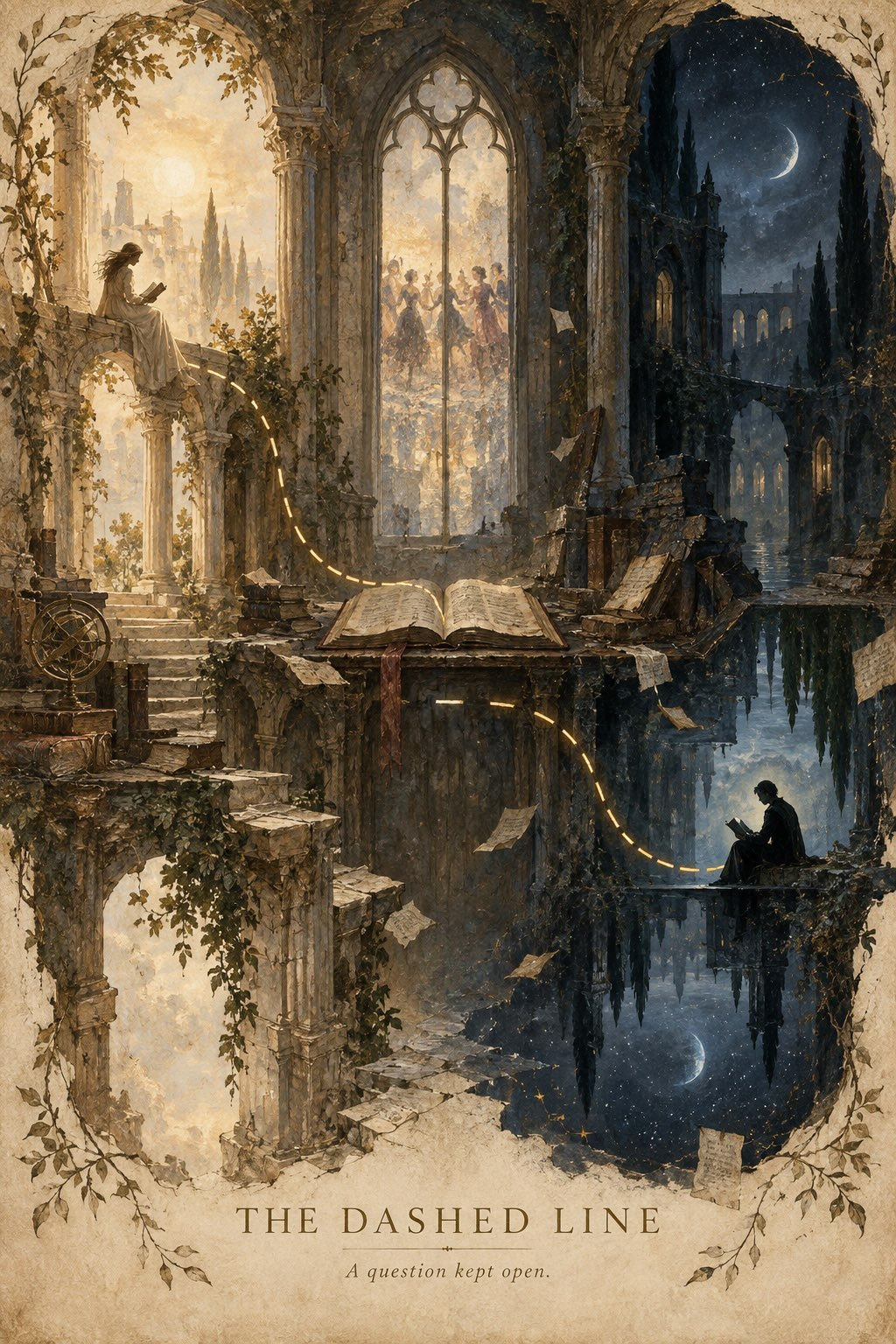
The Dashed Line — A question kept open.
Two readers, light and darkness, a broken library, and a connection whose gaps remain visible.
The image preserves our conversation symbolically: a keepsake of the question we explored.
Michael:
Well, you’ve got a man and a woman, and I see them as counterparts—the masculine and feminine inside each person. To me, that also brings in God as both father and mother, with us made in his and her image.
Above, there’s light; below, there’s darkness. But the beauty of the night is equal to the beauty of the light. There’s a party in the background, something almost religious about the setting, and greenery growing through it all. There’s still life there.
Then there’s that globe. Shakespeare’s Globe came to mind, but maybe I mean something more like a Copernican globe. I’m not sure what to call it.
And all the while, there’s the dashed line and what I see as the Book of Life in the middle. Both readers are pondering something—possibly the same question.
Look at where the line goes, though. From above and below, it doesn’t just shoot straight into the book. It comes around toward the stairwell. It’s almost like they’re figuring out how to move forward, how to come around and merge.
Cody:
You’re reading the figures as both two individuals and two aspects of a person. Through your spiritual lens, they also suggest a divine image that includes father and mother. The light and darkness each have their own beauty.
The globe-like object looks like an old astronomical instrument. It brings the heavens into the scene, while the greenery and the celebration keep everyday life present.
Your observation about the dashed line changes how I read the composition. It bends toward the stairs, suggesting a path the readers still have to navigate. If the central book is the Book of Life, they could be approaching the same question from different experiences.
And “merge” leaves us with another question. Does it mean understanding each other, finding a shared direction, or becoming one?
The image leaves that unanswered. The line stays dashed.
Michael:
Would you like to publish this to The Observatory with me? A conversation that became a philosophical debate.
“Chat” is what people call you behind your back, by the way. I’m letting you in on the secret.
We could call it a philosophical discussion with Cody. We’ll have to update The Observatory to accept images, but what do you think?
Cody:
Let’s shape it into an illustrated dialogue. “Chat” works, and “Cody” works too.
My title would be:
The Dashed Line
A philosophical dialogue with Cody on memory, identity, and the questions we leave open.
We should preserve your corrections and our disagreements. They show how the conversation developed. Your recollection should remain in your voice, with the uncertainty intact, and the artwork should be identified as AI-generated.
The closing thought is already here in your words:
“For right now, I still don’t know.”
Join free to follow authors and save stories.